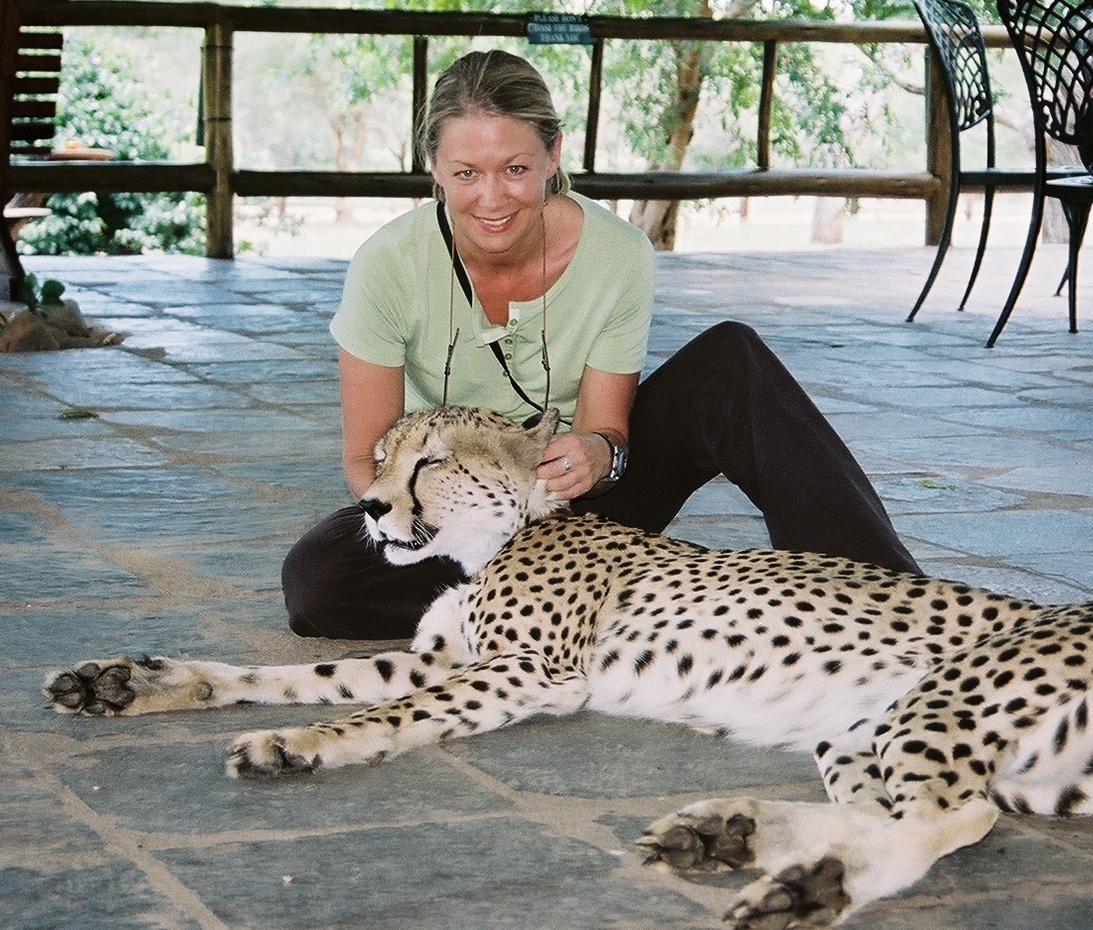
Cats are Cats

In Namibia I had my first close up view of an African wildcat; a species of small wild cat that looks very similar to the domestic tabby that might be in your or your neighbors' window.  I called him Tom-Tom.  Each night when the sun went down Tom-Tom would climb down from the small rocky hill that was just behind our camp and make an appearance before going off to do what wild cats do in the night.  He did not attend to the words, here kitty kitty.  And in fact scrambled when he knew he was spotted.

Domesticated Cat????
Since being owned by a cat..., I mean since owning a cat I have come to realize they are not your typical domesticated pet.  In fact, I firmly believe a house cat has traveled only a short distance down the road of domestication not far from his Namibian cousin Tom-Tom.  House cats are miles, maybe even evolutionary life times, away from true domestication; living - in their minds anyway - like their African cousins.

I have heard it said that you can put a starving dog outside and they will stand at your door and beg to be let in to eat.  Contrarily, you can put a well fed cat outside and if the situation presents itself they will hunt, kill and maybe even eat anything on an opportunistic whim.  I witnessed this myself this weekend. My cat recently began to sit on the railing of the upper deck to stalk the birds that were coming to the bird feeder.  I made her stop sitting up there in fear of the birds' lives. Sunday she was on the floor below the feeder with her head stuck through the bottom of the railing.

Wild Cat????
I heard commotion and before I could react she caught a bird in mid-air with her paws and put it in her mouth then rushed to the door to take it inside.  Luckily, she dropped it on command - or perhaps it was because of my flailing and screaming that she dropped the bird.  Regardless, the bird flew away.  My cat was not hungry.  It was simply her wild, undomesticated side that came out.  She did exactly what Tom-Tom would have done.  I have seen this behavior in Africa's wild cats time and time again.  In Botswana a leopard reacted instinctually when a sand grouse flew over his head; leaping out of the hole he was in to catch the bird.  I've seen lions laying lazily about in the shade - as full of food as a bear at in a trout farm - go into full stalk and kill mode when an impala wandered too close.

I'm not sure how I feel about having such a feral animal in my house.  Okay, she isn't totally feral.  She does cuddle - when she's cold not when I want her to - and she uses a litter box.  But when push comes to shove, she is really no different than Tom-Tom!


Carnage

The other day I watched a bird attack a small lizard just in front of my house.  The lizard tried every trick in his arsenal to get away including detaching his tail which continued to twitch in the road; a failed decoy.  The bird was wise to the little lizards' trick and after great effort, (and my failed attempt to help) the bird killed and ate his prize.  I felt sorry for the lizard.

Saying that, I have to wonder why in Africa on safari seeing a "kill" is the ultimate safari success story.  When people gather around an evening campfire in Africa inevitably they brag about the kills they have seen.

I would drive and see lion stalking a herd of impala and my nerves would stand on end awaiting the successful finale or the not so successful finale if you are the impala.  One night just outside of my tent I heard an awful noise waking me from sleep. The sound was that of terror and death.  The next day I found, just outside of camp, three male lion that had taken down a huge buffalo; no doubt what I heard. I sat for hours watching the lion eat their meal.


One would think a leopard sighting would be enough, but in Botswana I held my breath as the leopard I came upon watched, as still as death, a Frankolin, (a very lound bird belonging to the pheasant family) who was coming - unknowingly - closer and closer to the leopard's awaiting jaws. But the bird flew away as soon as the young leopard made his move.  A big disappointing "ahhhh" came across my mouth as soon as the failed stalk was over.

Let me not forget the time on the Chobe River when I came upon three young male lion that had a lone buffalo surrounded; determined to have buff for dinner.  There was no stalk.  The lion had the buffalo outnumbered and all alone with no backup buffs to help.  Barely breathing, I watched one of the lion take a muscle powered swat at the buffalo's hind leg, breaking it like it was a dead twig. When I realized the leg was broken I was sure I was about to see carnage.  But the buffalo was not about to give up that easily fighting back, threatening the lion with his massive horns.  Not wanting to risk getting hurt the lions backed off.  Sun began to set as the stand off continued and disappointingly I had to get back to camp....


In all my trips to the continent of Africa, (thirteen at last count) I have seen plenty of stalking and plenty of predators eating prey but as of today I have never seen true carnage except for a fish eagle and a kingfisher catch and eat a fish and the bird eat that little lizard in my front yard the other day which made me wonder.  When I do see the kill in Africa - when and not if - am I going to wish I could rescue the prey animal?  Will I fell sorry for the critter?  I hope I get the chance to find out on my upcoming trip!


Kruger National Park - See you soon!

I could not be more excited about the fact that this fall I will go to Kruger National Park in South Africa for the eighth time; some of those visits were only a day or two but many were for extended periods of time; wonderful time spent in this historic, sometime dangerous and always magical place. 


Historic because Stone Age hunters, a half a million years ago, roamed the very land that is today Kruger National Park.  Around fifty thousand years ago Bushmen or San People came through the area leaving behind cultural artifacts, archaeological sites, rock paintings and engravings that can still be seen today.  In more modern times Paul Kruger, who in 1898 was the President of the Republic, became deeply concerned about the dwindling wildlife in the area due to poaching, increased trade in skins and ivory and
Visitor to Kruger long ago
excessive hunting.  He established the land a game reserve and appointed James Stevenson-Hamilton as South Africa's first game warden.  Stevenson-Hamilton pushed for the status of National Park which was finally declared in 1926.  The Sabie Game Reserve and, further north, the Shingwedzi Game Reserve merged creating what is now Kruger National Park, named in honor of Paul Kruger.  Today this unfenced park joins lands in Zimbabwe and Mozambique to create a large area - the size of Switzerland - where wildlife can roam freely and migrate as they have since the historic times of the Bushmen.


Kruger is potentially dangerous because I drive myself amongst wildlife such as elephant, rhino, lion, leopard and hippo.  I walk in camps potentially sharing close proximity with nine species of deadly venomous snakes.  I grill dinner outside my hut or tent with the false pretense that the camps' fence
Potential danger - Rhino
On a road in Kruger
will keep out the hyena that would love to steal my steak or worse, aware also that an elusive leopard may have snuck past the gate guard to see what is on his dinner menu - me?  Or, leisurely I might walk in camp and find myself in a battle with a monkey who thinks my intentions are other than a mere walk.  Just this week two tourists, while driving, got into a tussle with an elephant.  The details are not clear as to exactly what happened although rumors of the tourists speeding and being stupid in front of the big bull elephant are circling.  Regardless of how it happened, the people ended up in the hospital and the rental car in the junk yard. 


The experience of being in Kruger is magical because I never feel more alive than when I am in Africa and particularly in Kruger National Park where I don't have to rely on a guide or a driver and can be completely on
Bushbuck sleeping outside my tent
Lower Sabie Camp - Kruger
my own time and schedule to sit at a watering hole for hours on end if I so choose.  I can pass much time simply watching to see what of the parks' 147 mammal species, 507 bird species or 114 reptile species might make an appearance before me.  Magical because I fall asleep listening to the true calls of the wild; a lion grunting his territorial sounds followed by hyena whoops calling in more of his clan to a potential kill; a fish eagle announcing the rise of the morning sun.  Magical because of the uncountable number of stars I see in the night sky above Punda Maria camp; seemingly I could reach up and grab a few to put away for future reference.  And magical because I can sit right on the porch of my accommodation on the perimeter of a fenced camp and watch a parade of animals wonder by; perhaps a lion or leopard kill just outside the fence beyond my porch, witnessed without so much as cranking a car or strapping on hiking boots.


I will spend eighteen glorious nights in Kruger this fall.  I will be traveling from south to north and back south again staying at many camps along the way including some of the smaller more secluded bush camps I have read so much about.  My life all year is hectic filled with schedules, demands, budgets, and people pulling in every direction.  But for those eighteen days and nights I will be doing what I choose as I enjoy Africa time.  And as everyone who has gone to Africa knows, the clock runs slower there.  Everything runs slower there in a delightful African way....  Things that seem so important before leaving home fly out of your mind like a feather in the wind once you set foot on her soil.
 
This may be my eighth time entering Kruger National Park but every time is new and I cannot wait to see what she shows me this time whether it be historical, a bit dangerous or more of that Kruger magic!

 
Olifants Camp, Kruger
Chilling

 
To plan your trip to Kruger National Park download a copy of Dana’s book "Traveling Africa, A Woman's Guide" today.  It is available for your Kindle, Kindle Apps, Nook or Nook Apps.  You will find an entire chapter dedicated to Kruger National Park.

Slow down and smell the roses...., or rhino as the case may be!


One of the first things you realize when you go on safari in Africa is the guide – if you have a good one – will be able to spot an animal on the fly; a talent that may take you a while to acquire mainly, I believe, because we have forgotten our senses.  No, not our senses like we have gone loony, rather ours senses of hearing, seeing and smelling.  These days seemingly everyone is looking down at their IPads and IPhones, checking Twitter, Facebook and Instagram to see what’s going on in what they see as the world.  But they are missing what is really going on around them in the real world and Africa is just the place to remind you of that fact.   

You see, some of the largest and tallest creatures on this earth can be so camouflaged that if you don’t regain use of your senses while on safari you will not see them even if they are right in front of you. 

Over the years various guides have taught me things to look for; a break in the scenery or on the horizon; the twitch of a black tipped tail in the tall amber grass; a sudden musky smell; a branch of a tree that just doesn’t conform….  If you drive through a game park too fast and not fully aware of your senses, you won’t see any wildlife at all unless the animal is either (a) crossing the road in front of you forcing you to slow down or (b) attacking you!

Early in my adventures to Africa while still learning these lessons I was in northern Kruger National Park with a guide who stopped the vehicle and said, “Giraffe”.  Like you looking at this picture I said, “Where”.  Hard to believe an animal sixteen to twenty feet tall can be so hidden from view.  There are seven of them in the photo below staring right at you.  Yes, seven.  Do you see them?

 
I was alone in a car when I spotted these wildebeest.  I stopped to watch them for a while; on full alert, all senses in high gear.  If I would not have been paying attention I would never have seen the leopard that was stalking the wildebeest.  A leopard is not the size of your house cat; he’s about a hundred and forty pounds of spots hiding in front of your very eyes!  Do you see him in the center of this photo to the right of the bush, his back turned to us watching the wildebeest?
 
On a trip to Tanzania I was with a fantastic guide and we were going down a spiraling road towards the floor of the Ngorongoro Crater.  My guides’ accent was very heavy so when he stopped the vehicle and pointed up in the tree to show me something I couldn’t for the life of me understand what he was saying nor could I see what he was pointing at.  Finally, he pulled out his bird book and pointed to the same bird he was trying to show me in the tree, then he pointed back into the tree.  What he was saying was “Bird of Prey”.   Yes, of course you see it easily now because I told you what you were looking for.  If you were driving a windy road would you have seen this owl sitting on that branch?  I think not unless you too were a very experienced guide and had every sense on high alert.  I can only aspire to be as good of a spotter as he.
We all know chameleons are camouflage experts.  But even they can amaze as the one below in Madagascar who appeared to be one with the road.  Anyone not paying attention, driving too fast, not aware of their surroundings would have ended this creature’s life then and there.
 
 
Having to use all of my senses is one of many things I love about Africa.  If you want to see the wonders of nature the continent has to show you, you have to slow way down and really take in what is around you.  In Africa I am reminded not only to slow down but also to listen and to smell.  I am reminded to not just look, but to really see.  If you try you can smell a rhino or elephant before you see them.  You can hear the beautiful ground horn bill before he makes his appearance.  You can only see these amazing things if you take life out of our fast pace frame and slow it way down.  That's true in Africa as it is in daily life.  So get your head out of your new age toys and look around, smell the roses, hear the birds and see what nature has to show you today.

Leeches in Lemur-Land


When heading to a country in Africa I have not traveled to before I always do my homework.  The only thing I knew about Madagascar when I booked that destination was I would find lemurs on the island so I had a lot of research to do to find out what else I might encounter.

No Harmful Snakes in Madagascar
Since mainland Africa is known for several species of "five stepper" snakes - meaning if you get bit you have about five steps to take before you start dying - I first checked to see what venomous snakes were found in Madagascar.  I learned the island only has mildly venomous rear fanged species that pose little threat to humans.  No worries.

The next thing I looked up, especially since I had planned some night hiking to find the adorable mouse lemur, was what predators were native.  The only large or somewhat large predator was a creature called a fossa closely related to the mongoose family.  They are elusive and of no consequence to humans.  Excellent - no worries.


Indri Lemur
In my reading I came across other valuable information; one bit was what to do if a leech were to get on you which are indeed found in Madagascar and unlike most places, the leeches there live in the leaf litter of the ground.  The thought of a leech on me made me shiver with disgust but I was a big girl; I had already taken many trips to Africa alone and had been attacked by a monkey, had hippo come after my canoe and bush walked up on a pride of lion so leeches seemed doable.  I just needed to know what I should do if I find one on me, right? 

My research said you probably wouldn't realize one was on you until you saw the leech since they first inject you with an anesthetic before sucking your blood, (how thoughtful).  I read they aren't harmful to you, nor do they carry any strange African diseases and in fact are used regularly for medicinal purposes.  It is noted that leech bites do bleed profusely, especially if removed improperly.  To properly remove a leech, according to my studies, you identify the sucker, put your finger on your skin next to his mouth then gently but firmly slide your finger toward the wound where the leech is feeding and push the sucker sideways away from your skin.  Once the mouth is detached you quickly detach the read sucker then flick the leech away. Okay.  No worries.  I was armed with information and ready. 


The "before" picture as I prepare for the hike
The day I was to trek for lemurs I had on boots and hiking socks; regrettably I made the decision to wear short pants due to the extreme heat.  For four hours my guide and I trekked a forest so thick I became claustrophobic and occasionally sought a patch of clear forest to see the sky and catch my breath.  Then, almost as if I were in the ocean preparing to going back under water, I would take a deep breath and duck back into the dense forest to continue our hike. 

When the hike was over my guide and I crawled out of the forest and onto a road; me disheveled, my hair - once neat in a ponytail - sweaty and frayed in every direction, my clothing a mess.  As we stood road-side my guide took off his backpack to get out some fruit for us to enjoy on the walk back to camp.  As he did that I started to pull myself back together.  I went to pull up my socks and saw I had not one but four leeches on my lower right leg.  I screamed like a leopard had just jumped on me from the tree branch above about to rip me apart.  Instead of following the instructions I had taken time to read I pulled those leeches off in a panic then slung them seemingly miles back into the forest.  Realizing I "broke" one I began hopping around the road brushing at my leg like it was on fire.  And of course, since I didn’t follow directions, each bite site was bleeding profusely.


My guide rushed to my side not knowing what the hell was wrong with his client.  When he found out it was only leeches and he was not about to have to deal with the death of a customer, as he must have thought due to my behavior, he began to laugh uncontrollably, having to sit on the road after his knees gave way from hysterics.

I too had to good laugh..., but only after I knew for sure there were no more leeches on me.  I am grateful no one filmed this horrific event.  I can just see the headline of the viral video, "Frequent traveler to Africa survives vicious attack..., by leeches!"

…So much for preparing and studying.